
Have you heard these before…
“Graduating with student loan debt is part of the college experience.”
“I have to concentrate on my studies now.”
Here’s what these people don’t know…
- 34% of graduates from public colleges had no student loans.
- 25% of graduates from private non-profit colleges had no student loans.
- 12% of graduates from private for-profit had no student loans.
Between 2007 and 2008, 1.7 million undergraduates graduated with no student loan debt. But… why is the media always talking about the $1.3 trillion student loan debt?
You know why? Because it gets views and the biggest emotion they target to get views is fear. Happiness doesn’t put money into their pocket. Fear puts money in their pocket.
That’s the job of the media companies. Fortunately, we’re not and we can give you the truth.
How do these 1.7 million undergraduates do it?
Based on our research, we came across 6 common characteristics among these successful students.
They went to an in-state public college
34% of graduates from public colleges had no student loans. If you want to increase your chances to graduate without any student loan debt, public colleges are your best bet followed by private non-profits like Harvard.
To put this into more perspective, over 80% of undergraduates who graduated debt-free are from public colleges and out of these 80%, 78% of them are from in-state public colleges.
They didn’t enroll for a for-profit college
Graduates from non-profit colleges are 300% more likely to graduate debt-free than the for-profit students. If you went to a private for-profit college, the chance of you taking on a student loan is 88%. Basically, the odds aren’t in your favour.
They used the 2-step graduation strategy
50% of students who graduated debt-free graduated and transferred from community colleges. 61% of students who received an associate’s degree from a public college graduated debt-free and 68% of them received a certificate from a public college.
We covered the 2-step graduation strategy in module 3 here.
They went to a low-cost college
A low-cost college doesn’t mean a low sticker price. We covered this in module 1 on picking the best value colleges based on your net income. A $40,000 sticker price might cost you $10,000. On the other hand, a $20,000 college might cost you $15,000 which makes that more expensive than the $40,000 college.
81% of students who graduate with no debt graduated from a college with tuition and fees under $10,000. When students are paying over $10,000 for their college, the chances of them graduating debt-free drops dramatically. Only 11.4% of students who went a college with tuition and fees over $10,000 graduated debt-free.
“Vanessa Joseph, a 31-year-old registered nurse in Iselin, New Jersey, did not graduate debt-free once, but twice. First, she earned a business degree from the public College of Staten Island, which charged a reasonable $2,000 a year in tuition. She lived with her mother, worked odd jobs as a magazine intern and language teacher, and cut daily expenses to the bone.” – Time
They know how to buy their textbooks
75% of debt-free students spend less than $1,000 per year on their college textbooks. We covered strategies you can use to save $2,620 on your college textbooks in module 3. The largest group of debt-free students spent less than $499 on their textbooks followed by 35.3% who spent $500 to $999
They lived off campus
The majority of debt-free students lived with their parents or off campus during their college years. According to College Board, the average cost of room and board in 2015-2016 is $10,138 at 4-year public colleges and $11,516 at private colleges.
With that money, you can buy a new iPhone every single month.
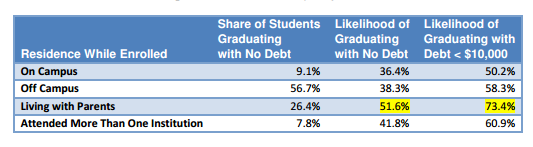
Among the students who graduated debt-free, only 9.1% of them who lived on campus succeeded. Surprisingly, there are 2x more debt-free students who lived off campus than living with parents. Does that mean living with your parents is more expensive than renting a room outside?
My theory is that when students who lived off campus they become more responsible which helps in their studies and also their expenses. They are more likely to work part-time compared to students who live with their parents.
They had help from their parents
36% of students who graduated debt-free are from low-income families while 45% of them came from middle-income families and followed by 56% from higher-income families.
However, your families income range isn’t the big factor here. It is this. Over 67% of debt-free students got help from parents when paying for college.
They have lower EFCs
51.2% of debt-free graduates came from families with income less than $50,000 followed by families with income of $50,000 to $100,000 at 29.1%. However, that doesn’t tell the full story because when it comes to paying for college, financial aid is a major factor here. When getting financial aid, it’s all about the COA and EFC.
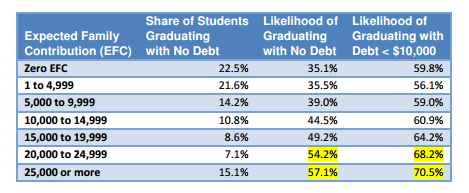
Take a look at this table. The lower your EFC, the higher your chances of graduating without student loan debt. There’s an exception here and that is for families who have EFCs over $25,000. These are probably the families who can outright pay for their child’s college without needing any financial aid.
Resources
- http://time.com/money/4046169/debt-free-college/
- http://ticas.org/sites/default/files/pub_files/Debt_Facts_and_Sources.pdf
- http://www.finaid.org/loans/20110824graduatingwithoutdebt.pdf